Start With Your Reference
Reference is the foundation of intentional animation, whether you are working on a bouncing ball, a creature walk, or a full acting shot.
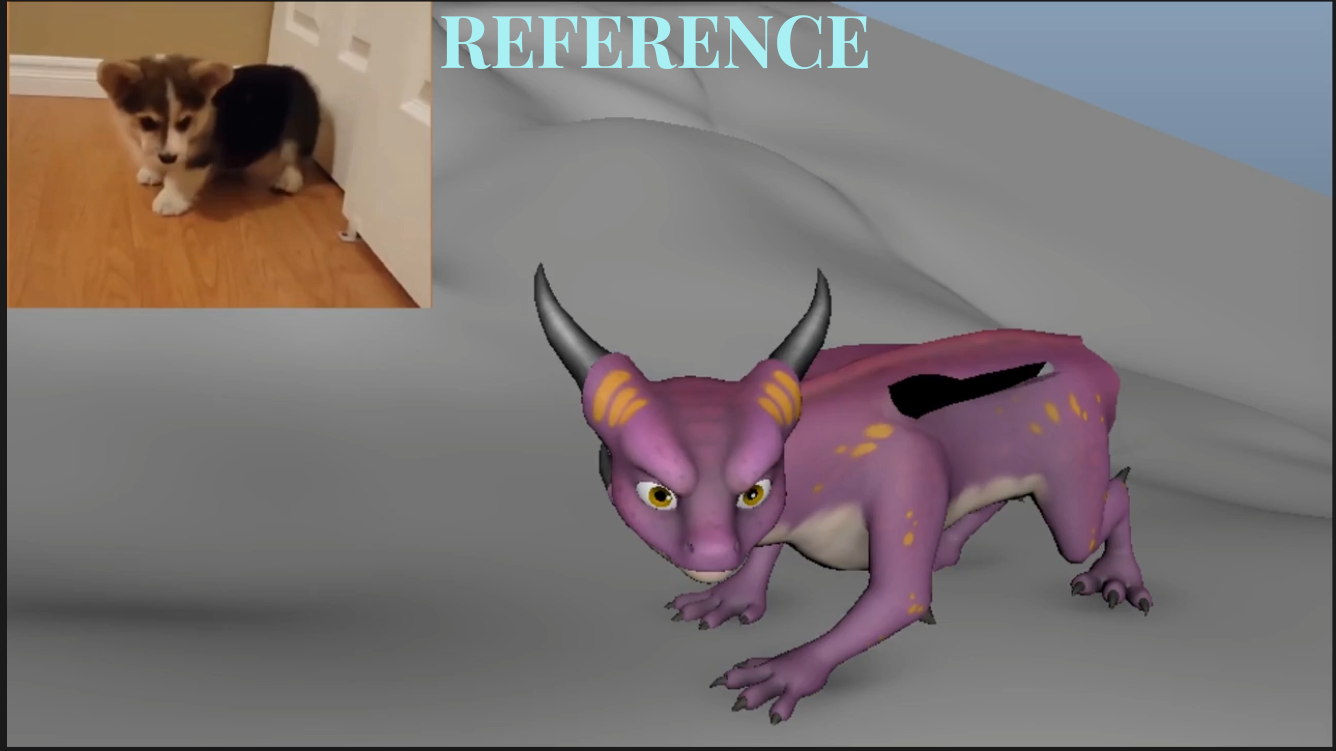
When submitting your work for feedback, include your reference in a corner of the frame where it does not obstruct the shot. Small enough not to distract, visible enough to be useful. This allows the reviewer to compare your poses and timing directly against your source material and to understand what you were going for.
Do Not Send a Screen Recording
Quality matters more than you think. A screen recording of your viewport introduces compression artifacts, frame drops, and inconsistent playback speed that make it genuinely harder to read timing and spacing accurately.
Export a proper playblast from your software at a consistent frame rate. Specify what that frame rate is. 24fps, 25fps, and 30fps read very differently, and a reviewer needs to know which world they are in.
If you are working on a cycle, include multiple camera angles: side, front, and perspective as a minimum. A walk cycle that looks fine from the side can fall apart completely from the front, and you want to know that.
Light Your Scene
Flat, unlit geometry makes it significantly harder to evaluate contact points, volume, and weight. You do not need a full lighting setup. A simple three-point light rig or ambient occlusion pass is enough.
Good lighting reveals the silhouette. It shows where the foot actually contacts the ground, how the body mass shifts, whether the overlap is reading. These are things that disappear in a grey blob of unlit geometry.
Give Your Shot a World to Move In
For dynamic shots especially, place simple geometry in your scene: boxes, planes, basic shapes, to give the eye reference points in 3D space.
Movement reads differently when there is something to move past. A character jumping across an empty void tells you very little. The same jump over a crate tells you everything about arc height, timing, and landing weight.
Know Your Camera
Work out your final camera early and animate to it.
Include your final camera in the playblast. If the reviewer is watching a different frame than the one the shot will be seen in, their notes on composition, silhouette, and staging will not apply to what actually matters.
No Music
It feels natural to add a track under your shot. It sets a mood, fills the silence, makes the playback feel more alive. It also makes it significantly harder to read your animation.
Music manipulates emotional perception. A mediocre acting performance can feel compelling set to the right track. A timing issue can be masked by a beat. A reviewer listening to music while watching your shot is not giving you notes on your animation. They are giving you notes on your animation plus the emotional scaffolding the music is providing.
When to Ask for Feedback
This might be the most important section of this entire article, because timing your feedback request correctly can save you weeks of wasted work.
The earlier you ask, the more your work benefits. The later you ask, the more you learn.