What Overlap Actually Is
In real movement, nothing stops all at once. When you reach for something and pull your arm back, the shoulder leads, the elbow follows a beat later, the wrist after that, the fingers last. Each part of the body is responding to the part above it in the chain. This staggered response is overlap.
Follow through is the continuation of movement after the main action has ended. The cloth that keeps swinging after you stop walking. The hair that catches up to the head a few frames after the head has settled. The two principles are related, and they are often confused.
Follow through is about continuation. Secondary elements keep moving after the primary action has stopped. They overshoot the final position, then settle back into it.
In practice these two things happen together, and understanding both starts with one central question: which part of the body is leading?
The Breakdown Is Where It Happens
Once your key poses are set, you add breakdowns. These are the poses between your keys that define how the body moves from one position to the next. The breakdown is where overlap lives.
If you leave the software to generate its own breakdown, you get everything at 50 percent. Every joint is exactly halfway between the two keys, at exactly the same time. There is no leading part, no following part. The body moves as a single rigid object. It reads as mechanical because it is.
At every breakdown, you are deciding which part leads and which part follows. The software cannot make that decision for you. It can only split the difference.
To create overlap at the breakdown, you offset the timing of different body parts. The part that leads goes further toward the next key. The parts that follow stay closer to where they came from, or in some styles they are counter-animated entirely, moving briefly in the opposite direction before catching up.
The degree of offset depends on the style of your animation. A realistic character in a grounded drama will have subtle offsets. A cartoon character in a broad comedy might have the head arriving two full seconds after the body. Both are using the same principle.
Who Leads Is the Creative Decision
Sometimes the physics of the action tells you who leads. In a jump, the force originates from the legs pushing off the ground. The legs lead, the hips follow, the chest follows the hips, the head follows the chest. That sequence is not a convention. It is the mechanical reality of how force travels through a body.
But sometimes the choice is yours, and that choice carries meaning.
Consider a character who has just finished a conversation and needs to turn and walk away. Who leads?
If the head leads and the feet follow, the read is disinterest, disappointment, or simply moving on. The character is done.
If the feet lead and the head follows last, the read is reluctance. The body is leaving but the gaze stays. The character is not quite done.
A Real Example: Ronan and the Gem
The screenshots below are from the opening of The Last Gem. Ronan is focused on the Gem. His attention is captured. Watch what leads.
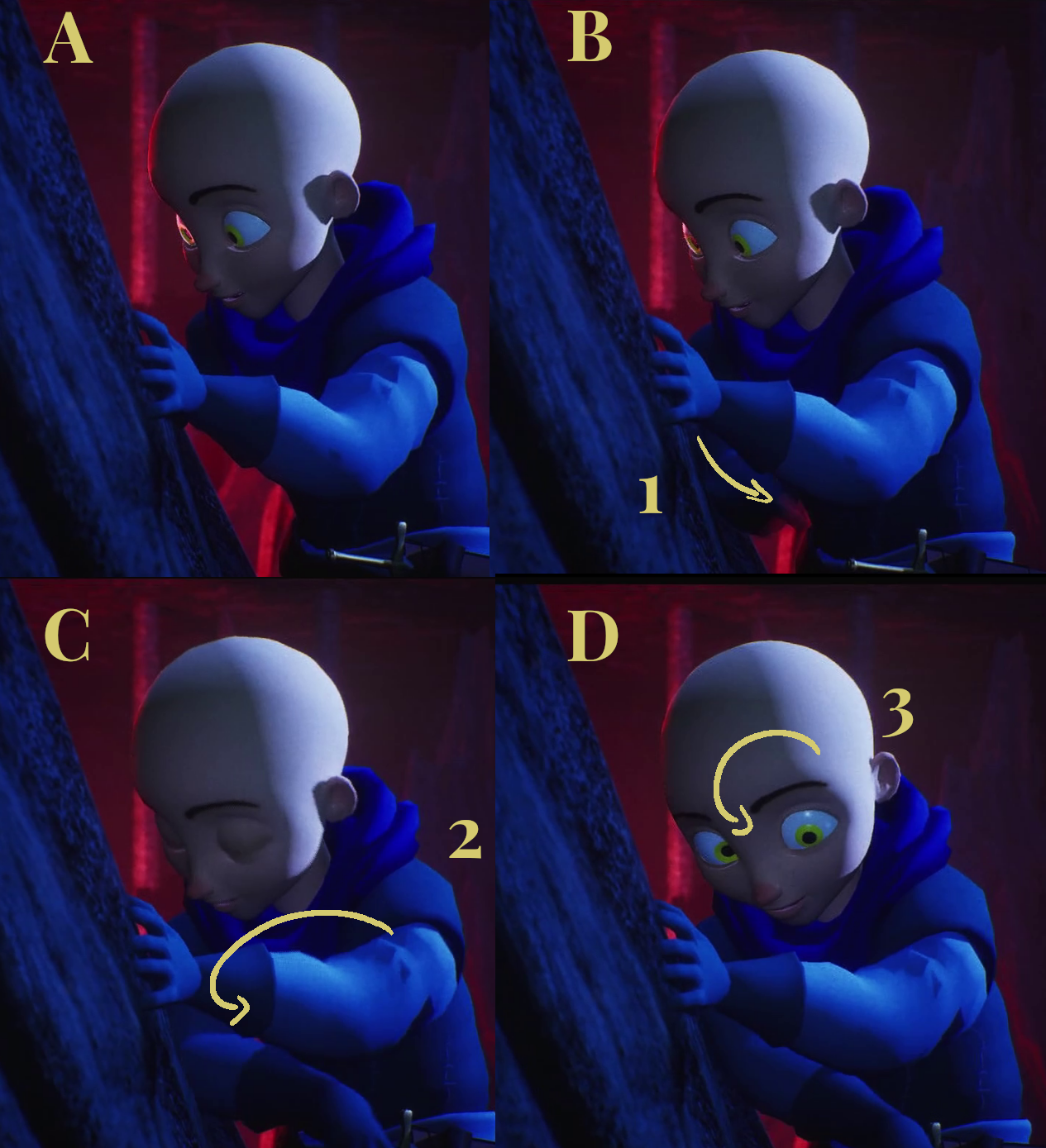
In frame A, Ronan is still. In frame B, the hand moves first toward the gem. In frame C, the body follows. In frame D, the head turns last, eyes wide as the gaze finally locks onto the target.
Three body parts, three different frames, one continuous feeling of weight and intention.
The hand leads because it is reaching for something specific. The body follows because it is drawn along by the arm. The head turns last because the character is still processing what he is seeing. That sequence is not just anatomically logical. It communicates something about the character's state of mind: instinct first, then commitment, then full awareness.
Break any action into its component parts. Assign each part a position in the sequence. The result is overlap, and it costs you nothing except the decision itself.
Going Deeper: Parts Within Parts
Once you start thinking in sequences, you can go as deep as the shot requires. A body is not just head, chest, and hips. An arm is a sequence: shoulder, elbow, wrist, hand, fingers. A face is a sequence: brows, eyes, nose, mouth. The eyes alone can be broken down further: brows, lids, iris.
In most shots, you will not need to think about all of these. But when a moment calls for it, knowing they exist gives you tools that most animators never reach for.
A grief reaction that plays brow first, then lid, then a barely perceptible shift in the mouth reads as real in a way that is difficult to explain but impossible to miss. The audience does not see the sequence. They feel it.
Drag: When Overlap Goes Further
Drag is overlap taken to an extreme. Instead of simply arriving late, the trailing part continues moving in the original direction for a moment after the leading part has stopped or changed course. It overshoots, then corrects.
A ponytail that swings past center before settling back is drag. A tail on a running quadruped that continues forward as the animal turns is drag. A cartoon character whose head lags so far behind a fast run that it appears to float in the previous position is drag.
The principle is the same as overlap, but the stakes are higher. Drag makes follow through visible. It takes what was a timing offset and turns it into a physical arc in space.
Drag belongs in high-energy moments, fast action, or stylised performances. In naturalistic acting shots, a light touch of follow through is usually enough. Reserve drag for moments where the physics need to be felt, not just implied.
Creatures, Tails, and Everything Else
Everything discussed so far applies beyond the human body. A creature is a chain of chains. A tail is a spine that keeps going. Wings are arms with more segments. The same question applies to all of them: who leads, who follows, and by how much?
For tails, the base leads and the tip follows. The longer the tail, the more frames of lag you have to work with. A short lizard tail might have four frames between base and tip. A long dragon tail might have fifteen or twenty, with the tip sometimes still moving in the previous direction while the base has already committed to the new one.
The most useful thing you can do with creatures is watch real ones. Not to copy what they do, but to understand why they do it. The physics underneath the fur or the scales is the same physics that governs a human arm. Force originates somewhere, and everything else responds.
Overlap does not happen by accident. It happens when you decide, at every breakdown, which part moves first. That decision is cheap to make and expensive to skip. Start there, and the rest follows.